
You’re staring at your transcript. 2.1 CGPA. Four semesters down. The scholarship office sent you a “probation warning” email this morning. Your parents keep asking how studies are going, and you keep saying “fine” while your stomach twists into knots.
Here’s what nobody told you during orientation: your CGPA is not a permanent sentence. It’s a number built on a formula, and formulas can be reverse-engineered. This guide will show you exactly how students at NUST, FAST, COMSATS, LUMS, UET, and other HEC-recognised universities have climbed from academic probation to dean’s list territory.
No motivational fluff. No miracle shortcuts. Just the mathematical reality of CGPA improvement and the exact strategies that work within Pakistani university systems.
Start Here: Find Your Situation
If you’re in Semesters 1-2 with low grades, you have the most significant recovery potential. A 2.0 can become 3.2+ by graduation.
If you’re in Semesters 3-5 with a CGPA below 2.5, you’re in the critical window. The strategies in this guide can help you reach 2.8-3.2 by the final year.
If you’re in Semesters 6-8 with a low CGPA, recovery is limited but still possible. Focus on crossing minimum thresholds (2.5 for jobs, 2.7-3.0 for MS admissions).
Why Your CGPA Actually Matters (The Real Stakes)
Let’s be honest about what’s riding on this number:
Financial Reality:
- HEC Need-Based Scholarship: Minimum 2.5 CGPA required, 3.0+ preferred
- University merit scholarships: Usually 3.5+ threshold
- Fall below 2.0-2.2 = Academic probation = potential fee doubling for repeated courses
- One repeated 4-credit course = PKR 15,000-40,000, depending on the university
Future Opportunities:
- MS/MPhil admissions: Most HEC universities want 2.7-3.0 minimum, competitive programs want 3.5+
- Corporate hiring (especially multinationals): Many filter resumes at 3.0 CGPA
- Competitive internships (P&G, Unilever, tech companies): 3.0-3.3 minimum
- Civil service exams: CGPA doesn’t matter, but university degree completion does (2.0-2.5 minimum)
Immediate Consequences:
- Below 2.0-2.2 = Academic probation warning
- Two consecutive probation semesters = Possible dismissal from program
- Below the minimum CGPA at graduation = Degree withheld until improvement
The point isn’t to scare you. It’s to make the stakes clear, so you know why the work ahead matters.
The CGPA Formula (How the Machine Actually Works)
Most Pakistani students don’t truly understand how CGPA is calculated. They think “get better grades” without realising that not all grades are created equal.
The Basic Math
Step 1: Grade Points × Credit Hours = Quality Points
Step 2: Total Quality Points ÷ Total Credit Hours = CGPA
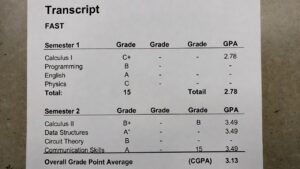
Real Example from a FAST Student
Semester 1:
- Calculus I (4 credits): C+ grade (2.33 points) = 9.32 quality points
- Programming (3 credits): B grade (3.00 points) = 9.00 quality points
- English (3 credits): A grade (4.00 points) = 12.00 quality points
- Physics (4 credits): C grade (2.00 points) = 8.00 quality points
- Lab (1 credit): B+ grade (3.33 points) = 3.33 quality points
Total: 15 credit hours, 41.65 quality points. Semester GPA: 41.65 ÷ 15 = 2.78
Semester 2:
- Calculus II (4 credits): B+ grade (3.33 points) = 13.32 quality points
- Data Structures (3 credits): A- grade (3.67 points) = 11.01 quality points
- Circuit Theory (4 credits): B grade (3.00 points) = 12.00 quality points
- Communication Skills (3 credits): A grade (4.00 points) = 12.00 quality points
- Lab (1 credit): A grade (4.00 points) = 4.00 quality points
Total: 15 credit hours, 52.33 quality points. Semester GPA: 52.33 ÷ 15 = 3.49
CGPA after Semester 2:
- Combined: 30 credit hours, 93.98 quality points
- CGPA: 93.98 ÷ 30 = 3.13
The Critical Insight Most Students Miss
Notice what happened: The student went from 2.78 to 3.13 CGPA in just one semester. How?
The semester GPA (3.49) was significantly higher than the existing CGPA (2.78).
This is the golden rule: Your CGPA only improves when your current semester GPA exceeds your cumulative CGPA.
If your CGPA is 2.5, getting a 2.6 semester GPA barely moves the needle. You need 3.3-3.7 semesters to see real improvement.
Why Credit Hours Are Your Secret Weapon?
Here’s where strategy separates average students from smart ones.
Scenario: You Want to Raise Your CGPA from 2.4 to 2.7
You have two courses you’re struggling with:
Option A: Improve Database Systems (2 credits) from C to A
- Quality point gain: (4.0 – 2.0) × 2 = 4.0 points
Option B: Improve Digital Logic Design (4 credits) from C to A
- Quality point gain: (4.0 – 2.0) × 4 = 8.0 points
Option B has twice the impact due to credit hours.
The Practical Application
High-Impact Courses to Prioritise:
- Lab courses with 3-4 credits (not the 1-credit labs, the design/project labs)
- Core engineering/CS courses: Usually 3-4 credits
- Mathematics courses: Almost always 3-4 credits
- Capstone/FYP: Often 6-8 credits in the final year
Lower-Impact Courses (Still Important, But Strategically Secondary):
- 2-credit electives
- 1-credit labs
- 2-credit general education courses
This doesn’t mean ignore low-credit courses. It means when you have limited time and energy (which you do), invest disproportionately in high-credit courses.
Read also: CGPA vs. GPA: Understanding the Difference & Calculations
University-Specific Grade Improvement Policies (Know Your Rights)
This is where students lose thousands of rupees and entire semesters because they didn’t read the fine print.
NUST Grade Improvement Policy
- You can repeat courses where you got a D or an F grade
- Only the latest grade counts (the old grade is completely replaced)
- Maximum 2 attempts per course allowed
- You must repeat during the summer or the next available semester
- Repeated courses show “R” notation on transcript (MS admissions offices can see this)
Real Story: Bilal got an F in Engineering Mechanics (4 credits). He repeated it and got a B+. His CGPA jumped from 2.1 to 2.5 because those 4 credits went from 0 to 3.33 quality points per credit.
FAST Grade Improvement Policy
- Similar to NUST: Latest grade replaces old grade
- You can improve grades of C, D, or F
- A maximum of 18 credit hours can be repeated across the entire degree
- Fee charged at current semester rates (usually full course fee)
Critical Mistake to Avoid: Sara repeated 5 courses (20 credits total) in the hope of improving everything. FAST only allowed 18 credits. Her last two repeats didn’t count, and she wasted PKR 50,000+.
COMSATS Grade Improvement Policy
- Allows grade improvement for courses with a C or below
- Old grade is averaged with the new grade in some departments (check with your campus)
- Different campuses have slightly different policies
- Maximum repeat limit varies by program (usually 15-18 credits)
The Averaging Trap: Ahmed repeated Calculus II, where he had a D (1.0). He got a B+ (3.33) on the repeat. He expected his grade to become B+, but COMSATS Lahore averaged them: (1.0 + 3.33) ÷ 2 = 2.17 (C+). His 4-credit course improved his CGPA less than expected.
Virtual University Grade Improvement
- Offers “Improvement Exam” facility
- You can appear in improvement exams for up to 50% of the total courses
- Only the final exam is re-attempted (internal assessment stays the same)
- Better grade replaces old grade
Strategy: VU students should attempt improvement exams for high-credit courses where they performed poorly in finals but did okay in assignments.
UET Lahore Grade Improvement
- Allows re-enrollment in failed courses
- Grade improvement allowed for D grades with approval
- Some departments allow improvement for C grades
- Policies differ slightly between departments (Civil vs Electrical vs Mechanical)
Action Item: Before You Repeat Any Course
- Download your university’s academic regulations (usually on the website)
- Email your Program Coordinator and ask: “If I repeat [Course Name], will my old grade be replaced or averaged?”
- Calculate the financial cost: Course fee × number of courses
- Calculate the opportunity cost: Will delaying graduation cost you?
Don’t trust what seniors or friends say. University policies change. Get written confirmation.
Real Recovery Timelines (Setting Realistic Expectations)
Students always ask: “How long will this take?” Here’s the mathematical reality based on actual student data:
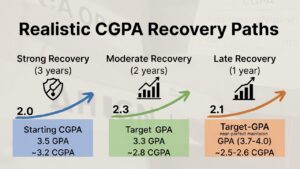
Scenario 1: Strong Early Recovery (Best Case)
Starting Point: 2.0 CGPA after Semester 2 (30 credits completed). Remaining: 6 semesters, approximately 90 credits. Strategy: Average 3.5 GPA per semester for the remaining semesters. Result: Final CGPA = approximately 3.2
Timeline: 3 years. Realistic? Yes, if you implement everything in this guide starting now.
Scenario 2: Moderate Recovery (Most Common)
Starting Point: 2.3 CGPA after Semester 4 (60 credits completed). Remaining: 4 semesters, approximately 60 credits
Strategy: Average 3.3 GPA per semester. Result: Final CGPA = approximately 2.8
Timeline: 2 years. Realistic? Yes, achievable with focused effort and strategic course selection.
Scenario 3: Late Recovery (Hardest, Still Possible)
Starting Point: 2.1 CGPA after Semester 6 (90 credits completed). Remaining: 2 semesters, approximately 30 credits. Strategy: Perfect 4.0 GPA both semesters (tough). Result: Final CGPA = approximately 2.6
Timeline: 1 year. Realistic? Unlikely to hit 4.0 twice, but a 3.7-3.8 average could get you to 2.5, which crosses the probation threshold.
The Hard Truth About Final Year Recovery
If you’re entering the 7th or 8th semester with a low CGPA, you have limited mathematical room for improvement. A student with a 2.0 CGPA and only 20 credits remaining cannot reach a 3.0 CGPA even with perfect grades.
But you can:
- Cross the 2.5 threshold to avoid probation
- Reach 2.7-2.8 to become eligible for some MS programs
- Demonstrate an upward trend (significant for grad school applications)
The lesson: Start early. Every semester you delay, recovery becomes exponentially more complicated.
The 5-Step CGPA Improvement System
Step 1: Calculate Your Recovery Target
Use this formula to know if your goal is even mathematically possible:
Required Semester GPA = (Target CGPA × Total Credits) – Current Quality Points ÷ Remaining Credits
Example:
- Current CGPA: 2.3
- Current credits completed: 60
- Current quality points: 2.3 × 60 = 138
- Remaining credits: 60
- Target CGPA: 3.0
Required GPA = (3.0 × 120) – 138 ÷ 60 = 360 – 138 ÷ 60 = 222 ÷ 60 = 3.7
Translation: You need to average a 3.7 GPA across all remaining semesters. Difficult but achievable.
If the required GPA is above 4.0, your target is mathematically impossible. Adjust your target downward.
Step 2: Identify High-Impact Courses for Repeat/Improvement
Make a spreadsheet of all your grades. Sort by:
- Credit hours (highest first)
- Grade received (lowest first)
- Repeat eligibility (D and F grades first if your university allows)
Your priority list is courses that are:
- High credit (3-4 credits)
- Low grade (D, F, or C)
- Allowed for repeat under your university’s policy
Example Priority List:
CourseCreditsCurrent GradeQuality PointsPotential Gain (if improved to A)
Circuit Theory 4 D (1.0) 4.0 12.0 (4.0×4 – 1.0×4)
Data Structures 3 C (2.0) 6.0 6.0 (4.0×3 – 2.0×3)
Calculus II 4 C+ (2.33) 9.32 6.68 (4.0×4 – 2.33×4)
Focus your repeat/improvement budget on Circuit Theory first, then Calculus II.
Step 3: Design Your “Recovery Semester” Load
Don’t overload. This is the most common mistake.
Students think: “I’ll take 21 credits this semester to finish faster and improve CGPA simultaneously.”
Result: They’re overwhelmed, get mediocre grades across all courses, and their semester GPA is only 2.7—barely moving their 2.5 CGPA.
Smart Recovery Load:
For Semester GPA Target of 3.5+:
- 15-16 credit hours maximum
- Mix of 1 challenging core course, 2 moderate courses, 1-2 easier electives
- No more than 2 math-heavy courses simultaneously
- Include at least one course you’re genuinely interested in (motivation matters)
Example Balanced Semester:
- Operating Systems (4 credits, challenging)
- Database Systems (3 credits, moderate)
- Technical Writing (3 credits, easier, high grade potential)
- Elective: Mobile App Development (3 credits, interesting)
- Lab (2 credits, straightforward if you attend)
This gives you 15 credits with realistic potential for a 3.5+ GPA.
For Semester GPA Target of 3.8-4.0 (Aggressive Recovery):
- 12-15 credit hours
- Maximum 1 genuinely challenging course
- Fill with courses where you have advantages: a good professor, a topic of interest, and past paper predictability
- Consider taking 1-2 courses in the summer to reduce semester load
Step 4: Implement Study Strategies That Actually Work in Pakistani Universities
Forget generic advice like “study more” or “stay focused.” Here’s what works explicitly in Pakistani university systems:
The Past Paper Strategy (70% of Your Grade Improvement)
Why This Works:
Pakistani universities, especially public-sector universities, have relatively predictable examination patterns. Faculty often recycle question styles, numerical problem types, and even entire questions from previous years.
How to Execute:
- Collect Past Papers:
- Department website (most HEC universities now upload these)
- Student WhatsApp groups (every department has one)
- Library physical copies
- Senior students (offer to buy them chai, they’ll share)
- Aim for the last 5-6 semesters minimum
- Analyse Pattern:
- Which topics appear every semester? (These are guaranteed questions)
- What’s the question format? (Derivation, numerical, short answer, MCQs)
- How many marks per question type?
- Are questions repeated verbatim or just similar?
- Practice Under Exam Conditions:
- Set a timer (actual exam duration)
- No notes, no phone
- Write complete answers, don’t just “solve in your head.”
- Do this for at least 3 past papers per subject
Real Example: At UET Lahore, Circuit Theory finals repeat 60-70% of numerical problems from previous years with slightly changed values. Students who thoroughly solve 10 past papers can predict 7-8 of the 10 final exam questions.
The Professor’s Office Hours Hack
This is the most underutilised strategy in Pakistani universities.
Most students never talk to professors outside class. Those who do gain massive advantages:
What to Ask During Office Hours:
- “What topics do you think are most important for the final exam?” (They’ll often tell you directly)
- “I solved this past paper question this way—is this the approach you prefer?” (Learn their marking preferences)
- “Can you clarify the grading breakdown for the project?” (Understand where easy marks are)
- “I’m aiming for an A in this course—what do students who get As typically do differently?” (Direct roadmap)
Timing Strategy:
- Go 2-3 weeks before midterms/finals (not the day before)
- Bring specific questions, not “I don’t understand anything.”
- If the professor seems helpful, build a relationship (they remember students who show effort)

The Grading Influence:
When final grades are borderline (you have 84%, the cutoff for an A is 85%), professors give the benefit of the doubt to students they recognise and know are trying. This isn’t cheating—it’s human nature.
Active Recall Over Passive Reading
Don’t Do This: Read the textbook chapter 3 times, highlight important parts, and copy notes.
Do This Instead:
- Read once (understand concepts)
- Close the book, write from memory (what were the 5 key points?)
- Check what you missed (those are your weak spots)
- Repeat for weak spots specifically
Practical Application:
For a course like Data Structures:
- After learning “Binary Search Trees,” close your notes
- On blank paper, write: definition, properties, insertion algorithm, deletion algorithm, time complexity
- Check your notes—what did you forget?
- In the following study session, start with what you forgot.
This feels harder than re-reading because it is. That’s why it works better.
Spaced Repetition for Formula-Heavy Courses
The Problem: You study Calculus formulas, understand them today, and forget them by exam day.
The Solution:
- Day 1: Learn the integration by parts formula
- Day 3: Practice it again (5 problems)
- Day 7: Practice again (3 issues)
- Day 14: Practice again (2 issues)
- Day 30: Practice again (1 problem)
By exam time, it’s in permanent memory.
Tools:
- Anki app (free flashcard app with built-in spaced repetition)
- Google Calendar reminders
- Physical flashcards with scheduled review dates
Best For:
- Mathematics courses (formulas, theorems)
- Physics (equations, laws)
- Programming (syntax, algorithms)
- Circuits (Kirchhoff’s laws, Thevenin’s theorem)
Strategic Group Study (Not Social Study)
Bad Group Study:
- 5 friends meet at the café
- Talk about cricket/politics for 90 minutes
- Solve 2 problems together
- Everyone goes home feeling productive, but learning nothing
Good Group Study:
- Everyone prepares individually first (solves problems alone)
- Meet for a specific purpose: “Today we’re solving Chapter 5 hard problems only.”
- Teach each other: The best way to learn is by explaining to someone else
- Time-boxed: 90 minutes maximum, then break or end
- Selective membership: Only include people who actually want to study
When Group Study Works Best:
- Numerical problem-solving courses (engineering mathematics, physics, circuits)
- Programming assignments (debugging together, but write your own code)
- Exam preparation week (quiz each other, explain concepts)
When to Study Alone:
- Theory memorisation (Pakistan Studies, Islamic Studies, technical definitions)
- Deep conceptual learning (operating system concepts, database normalisation)
- Practice exams (always do these alone under real conditions)
Step 5: Track Progress and Adjust Strategy
Monthly Check:
Calculate expected semester GPA based on:
- Quiz grades received so far
- Assignment grades
- Midterm performance
- Attendance (if it affects grading)
If your mid-semester GPA is tracking at 3.0 but you need 3.5, you know immediately to:
- Increase effort in remaining assignments
- Prioritise finals preparation
- Talk to professors about extra credit opportunities
- Focus more on high-weightage courses
Use CGPA Calculators:
Several Pakistani websites offer CGPA calculators:
- Enter your current grades
- Add expected grades for remaining courses
- See projected final CGPA instantly
This removes guesswork and keeps you motivated when you see progress. Learn the guide about CGPA calculations here (link).
Mental Health and Mindset (The Part Nobody Talks About)
Low CGPA destroys confidence. You start believing you’re not smart enough, that everyone else is better, and that you’ll never improve.
This is a lie your stressed brain is telling you.
Real Talk About Academic Struggles
You Are Not Your CGPA:
Your CGPA is a measurement of how well you’ve navigated a specific system under specific conditions. It’s not an intelligence test. Some of the most successful Pakistani entrepreneurs, engineers, and professionals had mediocre university GPAs.
Common Mental Health Issues Affecting Grades:
- Depression: Low energy, can’t focus, assignments feel impossible
- Anxiety: Panic before exams, can’t sleep, mind goes blank during tests
- Imposter Syndrome: “Everyone else belongs here except me.”
- Family Pressure: Constant comparison to cousins/siblings who are “doing better.”
If you recognise these feelings, you’re not weak—you’re human. And these feelings make it harder to improve your CGPA because they drain the energy you need for studying.

What actually helps?
Professional support: Many Pakistani universities offer confidential counselling services. If unavailable, students can use online therapy platforms or speak with academic advisors and helplines.
Self-care basics: Adequate sleep, light exercise, and regular social interaction are essential for memory, focus, and mental health. Ignoring these reduces academic effectiveness.
Reframing mindset: Replace self-critical labels with goal-focused statements that acknowledge the current situation while emphasising improvement and action.
Handling family pressure: Comparisons with others are unhelpful. Students can respond directly, explain a clear improvement plan, or limit information sharing if pressure harms mental health. Justifying CGPA to everyone is not an obligation.
How Long Does CGPA Improvement Take?
Approximate timelines:
- 1 semester: Small visible improvement
- 2 semesters: Noticeable CGPA rise
- 4 to 6 semesters: Major recovery possible, for example, 2.5 to 3.2+
Early action prevents irreversible CGPA damage.
Common Mistakes to Avoid
- Ignoring credit hour weight
- Repeating courses without policy confirmation
- Overloading semesters to finish early
- Relying only on final exams
- Assuming CGPA cannot improve after low early semesters
Most CGPA problems come from strategy mistakes, not intelligence.
Final Reality Check
Improving your CGPA in Pakistan is not about miracles or shortcuts. It is about understanding:
- How CGPA is calculated
- Which grades matter most
- Which university policies can you legally use
- How many semesters do you have left
When applied consistently, these methods work across engineering, business, IT, and social sciences degrees under the HEC semester system.