
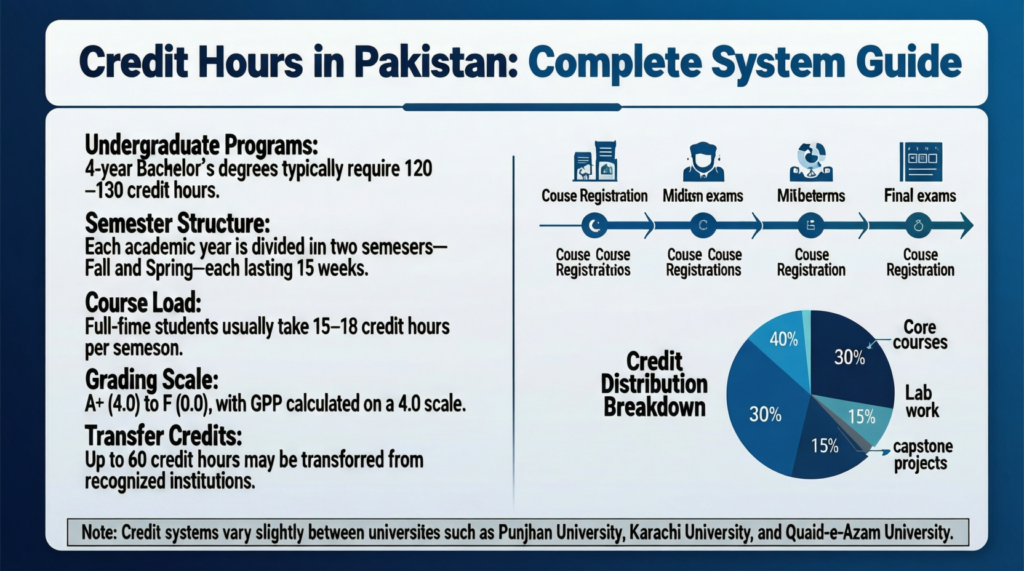
Credit hours form the foundational measurement system for academic workload across Pakistani universities operating under the Higher Education Commission (HEC) semester framework. This standardised unit quantifies course weight, determines full-time student status, and serves as the primary input for GPA calculations and degree completion requirements.
What Are Credit Hours?
A credit hour represents one contact hour of classroom instruction per week throughout a semester. In Pakistani universities following the HEC framework, this typically translates to:
- 1 credit hour = 1 lecture hour per week for 16–18 weeks (standard semester duration)
- Laboratory courses = 1 credit hour for 2–3 contact hours per week
- Tutorial or discussion sessions often carry fractional credits or are included within lecture credit allocation.
The system creates a weighted measure of academic engagement. A 3-credit course meeting three times weekly carries three times the academic weight of a 1-credit course in GPA calculations and degree requirements.
Credit Hour Structure Across Course Types
Pakistani universities classify courses by contact pattern and credit allocation:
Lecture-based courses: Most theory courses carry 2–4 credit hours. A 3-credit course typically meets for three one-hour sessions or two 1.5-hour sessions weekly.
Laboratory courses: Practical work carries lower credit-to-contact ratios. A 1-credit lab requires 2–3 hours of weekly attendance. Engineering and science programs combine lecture credits with separate lab credits (e.g., a 3+1 structure for a 4-credit course with integrated practical work).
Project or thesis work: Final year projects in BS programs typically carry 3–6 credit hours. The MS thesis work ranges from 6 to 12 credits, depending on the program structure.
Seminar courses: Often allocated 1 credit hour with weekly or fortnightly meetings.
Degree Completion Requirements
HEC guidelines establish minimum credit thresholds that universities must implement, although they may vary by program.
BS (Bachelor of Science) programmes: 120–136 credit hours over 4 years (8 semesters). Engineering disciplines typically require 130–136 credits. Business and social science programmes often require between 120 and 130 credits.
MS (Master of Science) programmes: 30–36 credit hours over 2 years (4 semesters). Research-based MS degrees allocate 18–24 credits to thesis work. Coursework-based programs distribute credits across 10–12 courses.
Professional degrees: MBBS programs operate outside the standard credit framework, using a year-based system. LLB and pharmacy programs follow modified credit structures aligned with professional accreditation bodies (Pakistan Bar Council, Pharmacy Council of Pakistan).
Distribution requirements mandate credits across:
- Core/compulsory courses (60–70% of total)
- Elective courses (15–25% of total)
- General education/university requirements (10–15% of total)
Credit Hours and GPA Calculation
Credit hours function as weighting factors in semester GPA (SGPA) and cumulative GPA (CGPA) calculations. The process follows this structure:
Grade point calculation: Each course grade converts to a numerical scale (typically 0.0–4.0). An A grade equals 4.0, a B equals 3.0, and so forth, according to university-specific grading scales.
Quality points: Multiply grade points by credit hours. A 3-credit course with an A grade (4.0) generates 12 quality points. A 4-credit course with a B+ grade (3.5) generates 14 quality points.
SGPA computation: Add all quality points earned in a semester, then divide by the total credit hours attempted that semester.
CGPA computation: Sum all quality points from all semesters, divide by total credit hours attempted across the entire program.
Higher credit courses exert greater influence on GPA outcomes. A poor grade in a 4-credit core course damages GPA more severely than the same grade in a 1-credit elective. Learn ways to improve your CGPA.
Credit Load Regulations
Pakistani universities enforce minimum and maximum credit limits per semester as per the Pakistani Grading System:
Full-time status: Typically requires 12–15 credit hours per semester. Students taking fewer than 12 credits may lose full-time status, affecting scholarships, hostel eligibility, and visa status for international students.
Normal load: Most universities set 15–18 credit hours as the standard range. First-year students often face mandatory limits of 15–16 credits.
Maximum load: Students with strong academic records (CGPA above 3.0 or 3.5) may register for 20–21 credit hours with departmental approval. Overload requests require justification.
Minimum load: Final semester students often take fewer credits (9–12) to complete remaining degree requirements.
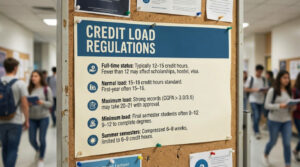
Summer semesters operate with compressed timeframes (6–8 weeks), limiting students to 6–9 credit hours.
Credit Hour Allocation Variations
Institutional approaches show systematic patterns:
Public sector universities (Punjab University, University of Karachi, Peshawar University) typically align closely with HEC minimum requirements. BS programmes in these institutions often require 124–130 credit hours.
Private sector institutions (LUMS, IBA Karachi, Habib University) frequently exceed HEC minimums, requiring 130–140 credit hours for BS programmes. Additional credits cover breadth requirements, interdisciplinary courses, or leadership development components.
Engineering universities (NUST, UET Lahore, GIKI) implement credit structures meeting both HEC and Pakistan Engineering Council (PEC) requirements. This drives credit totals toward 133–136 hours with prescribed distributions across engineering sciences, basic sciences, and humanities.
Virtual University operates within HEC credit frameworks but structures delivery around recorded lectures and online assessments. Credit hour definitions remain equivalent to traditional contact hours despite the asynchronous format.
Laboratory and Practical Credit Calculations
The divergence between contact hours and credit hours becomes most apparent in laboratory coursework:
A typical science or engineering lab requires 3 hours of weekly attendance but awards only 1 credit hour. This 3:1 ratio reflects the supervised nature of practical work versus independent study expectations for lecture courses.
Calculation methodology: Universities assume lecture courses require 2–3 hours of outside study per credit hour. A 3-credit lecture course demands roughly 6–9 hours of weekly student effort (3 contact hours plus 3–6 study hours). Laboratory courses involve minimal outside work; thus, the compressed credit allocation despite longer contact periods.
Studio courses in architecture or design programmes use similar ratios, often awarding 2 credits for 4–6 contact hours weekly.
Course Registration and Credit Planning
Students navigate credit hour systems through semester-by-semester registration:
Prerequisite chains: Courses with sequential dependencies (e.g., Calculus I → Calculus II → Differential Equations) determine multi-semester credit distribution. Registration systems enforce prerequisite completion before higher-level credit access.
Elective timing: Students optimise their GPA by scheduling lighter credit loads during semesters with difficult required courses, then taking additional elective credits during easier semesters.
Repeat policies: Failed courses must be repeated to earn credit hours. The repeated attempt appears on transcripts with both grades recorded, though only the higher grade typically counts toward CGPA (university policies vary). Some institutions include both attempts in CGPA calculations.
Credit transfers: Students switching institutions or programs face credit evaluation processes. Universities assess transferred credits against equivalent courses, often capping transfer credits at 50–60% of degree requirements.
Credit Hours in Academic Transcripts
Transcripts record credit hour data in standardised formats:
Each course entry shows:
- Course code and title
- Credit hours attempted
- Grade received
- Quality points earned
- Semester of completion
Semester summaries display:
- Total credit hours attempted and earned that semester
- SGPA for the semester
- Cumulative credits attempted and earned
- CGPA through that semester
Final degree statements specify total credit hours completed, confirming attainment of minimum degree requirements.
Common Credit Hour Challenges
Students encounter recurring difficulties with the credit system:
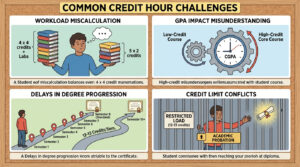
Workload miscalculation: Treating all courses as equivalent regardless of credit value leads to poor semester planning. A schedule with four 4-credit courses plus labs demands significantly more effort than five 2-credit courses, despite similar credit totals.
GPA impact misunderstanding: Students sometimes focus on grade improvement in low-credit courses while neglecting high-credit core courses that disproportionately affect CGPA.
Delays in degree progression: Not getting enough credits each semester means it will take longer to graduate. Students taking 12–13 credits a semester need 10+ semesters to reach the 130-credit requirements, exceeding the 8-semester standard timeframe.
Credit limit conflicts: Academic probation or warning status may restrict students to reduced credit loads (typically 12–13 credits), making timely degree completion difficult while simultaneously requiring them to raise CGPA through additional coursework.
Institutional Credit Hour Systems
Major Pakistani universities implement HEC frameworks with program-specific adaptations:
Punjab University BA/BSc programs use the semester system, with 124–130 credit hour requirements. Four-year programs spread credits over eight semesters, with a standard load of 15–16 credits per semester.
NUST engineering programs require 136 credit hours distributed across prescribed categories: 32 credits in basic sciences, 24 credits in humanities and social sciences, and 80 credits in engineering cores and specialisation areas. The structure meets PEC accreditation standards.
COMSATS University‘s BS programs typically mandate 130 credit hours with flexible elective selection (COMSATS Grading Scale). Computer science programs allocate 18–21 credits to elective courses, allowing specialised pathway development.
LUMS requires 130–135 credits for undergraduate degrees, with a breadth requirement that mandates credits across multiple schools (Humanities, Sciences, and Business). The distribution requirement adds 15–20 credits beyond major-specific courses.
Virtual University operates on standard HEC credit structures (130 credits for BS programs) but delivers them through asynchronous video lectures. One credit hour still represents one lecture hour of content, though students access material on flexible schedules.
HEC Credit Hour Framework
The Higher Education Commission establishes baseline requirements while permitting institutional variation:
Minimum credit thresholds: HEC specifies minimum credit hours for degree recognition. Four-year undergraduate programs must meet the 120-credit minimum. Two-year master’s programs require 30-credit minimums.
Quality assurance: HEC quality assurance frameworks evaluate whether credit hour allocations align with course learning outcomes, contact hours, and student workload expectations. Accreditation reviews verify compliance.
Program revisions: Universities submit new programs and major curriculum revisions to HEC for credit hour structure validation. The commission assesses whether proposed credit distributions meet discipline-specific standards.
Equivalence determination: HEC establishes equivalence protocols for credit systems across countries, enabling Pakistani students to transfer credits earned abroad and international students to apply credits earned in Pakistan.
Credit Hour Planning Strategies
Effective navigation of credit systems requires multi-semester planning:
Map degree requirements across 8 semesters, identifying which courses have prerequisite dependencies. Place difficult courses in semesters with lighter credit loads when possible. Distribute high-credit core courses to avoid concentrating them in a single semester.
Monitor CGPA trajectories by calculating expected outcomes under various grade scenarios for upcoming courses. Prioritise grade performance in high-credit courses when academic resources (study time, tutoring access) are constrained.
Use elective credits strategically. Take intellectually stimulating electives during semesters with manageable required course loads. Consider using electives to explore potential speciality areas or strengthen your GPA through achievable grade targets.

Understand repeat and withdrawal policies. Some universities exclude withdrawn courses from credit hour calculations, while others count them as attempted hours, affecting financial aid eligibility and satisfactory academic progress standards.
The credit hour system creates a transparent, quantifiable framework for measuring academic progress across Pakistan’s diverse higher education landscape. Understanding its mechanics—from GPA weighting to degree completion requirements—enables students to make informed registration decisions and plan efficient pathways toward graduation.