
A common student confusion
Many Pakistani students reach the end of a semester feeling confident about their results, only to feel confused when they see two different numbers on their transcript. One is GPA, the other is CGPA. Questions start immediately. Which one matters more, which one affects merit, and which one will universities or employers actually check? This confusion is very common, especially for first-year students.
Understanding the difference between GPA and CGPA is not just about numbers. It directly affects academic planning, scholarships, merit lists, admissions, and even future opportunities.
Why does this matter for Pakistani students?
Most universities in Pakistan follow a semester system and use both GPA and CGPA as part of their grading and evaluation process. Institutions like UAF, COMSATS, UETs, Punjab University, and many private universities rely on these metrics for decisions related to promotion, probation, merit, and degree completion.
If a student misunderstands GPA and CGPA, they may misjudge their academic standing. Some students panic after one weak semester GPA, while others feel overconfident without realizing their CGPA is slowly dropping. A clear understanding helps students make better academic decisions early.
What is GPA?
GPA stands for Grade Point Average. It’s a standard method to evaluate a student’s academic performance. Educational institutions often use it to summarize individual course grades into a single numeric value.
GPA is typically calculated on a scale ranging from 0 to 4.0. However, variations exist, with some schools using scales up to 5.0 or 6.0, depending on course difficulty. Understanding this scale is vital for students and educators to interpret academic achievements correctly.
The calculation involves converting letter grades into numerical equivalents. These numbers are then averaged across courses to determine a student’s GPA for a semester or year. Here’s a simple breakdown of how GPA scales align with letter grades:
- A = 4.0
- B = 3.0
- C = 2.0
- D = 1.0
- F = 0.0
Different institutions might use weighted GPAs, accounting for honors or advanced placement courses. This weighting influences the final GPA, reflecting course complexity. Understanding GPA is crucial for tracking student progress and setting attainable academic goals.
How is GPA calculated?
Calculating GPA may seem complex, but the process is straightforward once understood. GPA is determined by averaging the grade points from each course taken within a specific term. Most Pakistani universities use a standard formula.
-
Each course has assigned credit hours
-
Each grade has a grade point value
-
Multiply grade points by credit hours for each subject
-
Add all results
-
Divide by the total credit hours of the semester
It’s essential to understand this calculation because it influences decisions on coursework and academic planning. Tools like GPA calculators are available to simplify the process and help students anticipate their grades.
Formula in words
Total quality points divided by total credit hours
For example
If a student studies 5 subjects in a semester with a total of 18 credit hours, the GPA is calculated only from those 18 credit hours.
What is CGPA?
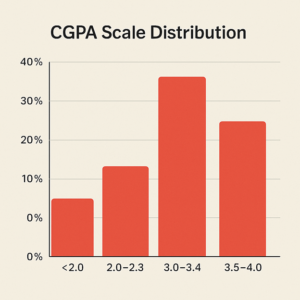
CGPA stands for Cumulative Grade Point Average. Unlike GPA, which measures performance over a term, CGPA assesses a student’s overall academic achievement across their entire program. It provides a comprehensive view of a student’s performance over time.
Globally, CGPA is prevalent in countries like India, Canada, and parts of Europe. It’s often utilized in educational systems where continuous assessment throughout the program is emphasized. Universities employ CGPA to offer a holistic view of student capabilities.
The scale for CGPA can vary significantly depending on the region or institution. Some countries use a 10-point scale, while others might employ a 4-point scale. Here’s a typical scale conversion for CGPA:
- 9.0 to 10.0 = Excellent
- 8.0 to 8.9 = Very Good
- 6.0 to 7.9 = Good
- 5.0 to 5.9 = Average
- Below 5.0 = Needs Improvement
For students, understanding CGPA is crucial. It can impact opportunities such as scholarships and honors, as well as playing a significant role in job applications and further studies.
How is CGPA calculated?
CGPA is calculated using:
-
All subjects studied so far
-
All credit hours completed
-
All grade points earned
It is not an average of GPAs. This is a very common misunderstanding.
Instead, universities calculate CGPA using total quality points from all semesters divided by total completed credit hours.
This means earlier semesters still affect CGPA, even in later years.
Key differences between GPA and CGPA
CGPA and GPA are pivotal in academics, but they cater to different aspects of performance evaluation. Understanding their distinctions can assist students in strategizing for academic excellence.
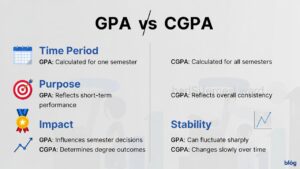
GPA focuses on short-term performance, typically over a semester or a year. Conversely, CGPA captures the long-term academic journey, summing up all courses taken throughout a program. This fundamental difference shapes how each metric is applied.
The scales for GPA and CGPA also differ. While GPA is often on a 4.0 scale, CGPA could be on a 10.0 scale, varying by institution. The choice of scale impacts how scores are interpreted in different educational contexts.
Here are key differences summarized:
- Time Frame: GPA = Short-term; CGPA = Long-term
- Scale: GPA = Usually 4.0; CGPA = 10.0 or varies
- Focus: GPA = Immediate performance; CGPA = Holistic academic view
Understanding these differences empowers students. Navigating through academic systems becomes easier, as does setting achievable goals aligned with their educational environment.
Is CGPA or GPA more important?
While both measure academic success, they serve different purposes in your portfolio:
CGPA (Cumulative Grade Point Average): This is the “big picture” metric. It reflects your entire academic history and is the standard used for graduation eligibility and graduate school admissions.
GPA (Grade Point Average): This acts as a “snapshot” of your performance. It tracks your progress within a single semester or a specific block of courses, offering immediate feedback on how you are handling your current workload.
Why Both Matter?
Think of your GPA as the building blocks for your CGPA. Consistently strong semester scores are the only way to secure a competitive final average.
In the real world, these numbers often act as initial filters. Many employers and top-tier universities use both metrics during the screening process to identify candidates with a proven track record of consistency and dedication. Ultimately, a high standing in both areas serves as a powerful asset for opening doors to advanced education and career growth.
Practical academic scenarios
Scenario 1: A low semester GPA
A student scores a GPA of 2.3 in one semester due to adjustment issues. However, their CGPA remains 3.2 because previous semesters were strong.
In this case, the situation is not as serious as it may feel. The low GPA signals a problem that needs correction, but the CGPA shows overall stability.
Scenario 2: Improving CGPA over time
Another student starts university with a CGPA of 2.6 after two semesters. By consistently scoring higher GPAs in later semesters, they gradually raise their CGPA to 3.1 by final year.
This shows that CGPA rewards long term improvement and discipline.
Scenario 3: Merit and admissions
When applying for MS admissions, universities usually look at CGPA, not individual semester GPAs. A single low GPA semester rarely disqualifies a student if CGPA meets the requirement.
This is why focusing only on GPA without tracking CGPA can be misleading.
Common mistakes and misconceptions
Thinking CGPA is the average of GPAs
This is one of the most common errors. CGPA depends on total credit hours, not simple averaging. A semester with more credit hours affects CGPA more heavily.
Ignoring early semesters
Some students believe early semesters do not matter. In reality, early low grades stay in CGPA calculations unless courses are repeated according to university policy.
Overreacting to one semester
A single low GPA does not define a student. CGPA provides a more balanced picture. Academic recovery is possible with consistent effort.
Assuming all universities calculate the same way
While the general method is similar, grading scales and policies can vary. Always check your university’s official grading system or handbook.
GPA and CGPA in Pakistani grading systems
Most Pakistani universities follow a 4.00 scale, although grading thresholds may differ slightly. Common grades include:
-
A or A+ for excellent performance
-
B range for good performance
-
C range for satisfactory performance
-
D for pass
-
F for fail
Some universities also have policies for:
-
Repeating courses
-
Improving grades
-
Academic probation based on GPA or CGPA
Understanding these policies helps students plan strategically rather than emotionally.
How students should use GPA and CGPA together?
Instead of focusing on only one number, students should use both.
-
Use GPA to evaluate semester performance and study habits
-
Use CGPA to track overall academic health
-
Set realistic improvement targets each semester
-
Identify weak subjects early and seek support
This balanced approach reduces stress and improves outcomes.
GPA and CGPA Scales Around the World
Understanding the various GPA and CGPA scales used globally is essential for students planning to study abroad. While the United States predominantly uses a 4.0 GPA scale, other countries have their unique grading systems.
Many institutions outside the U.S. might employ a 10-point CGPA scale. This can significantly affect how academic performance is perceived across different education systems. Knowing these differences allows for accurate conversion and comparison of scores.
Common GPA Scales:
- 4.0 Scale: Predominantly used in the U.S.
- 5.0 Scale: Utilized in a few schools for weighted grades.
Common CGPA Scales:
- 10.0 Scale: Used in India, Singapore, and other countries.
- 4.0 Scale: Some institutions may also apply this for CGPA.
Being aware of these varied scales helps in setting realistic academic goals. Comparing grades from different systems might seem daunting, but it’s an excellent opportunity for students to showcase their adaptability and academic potential.
Such global perspectives on grading systems not only prepare students for international education but also enhance their understanding of diverse educational frameworks.
A calm next step
If you are unsure about your current standing, calculate both your GPA and CGPA accurately using official formulas. Review your transcript, credit hours, and grading scale carefully. This clarity allows you to plan future semesters with confidence and realistic goals.